The MSqnet DCL (Data Collector) provides intelligent torque data collection for industrial fastening applications.
Industrial Application
MSqnet DCL (Data Collector) is an Android application designed for intelligent torque data collection in industrial environments, integrated into the M.Shimizu software ecosystem.
The application supports both manual torque data collection and test route execution, with automatic transmission of test results to the MSqnet Desktop software.
MSqnet DCL Torque Control
Key Features
Free Test: Independent torque data collection without requiring a pre-configured test route.
Route Execution: Create test routes directly in the app, perform fastening tests, and automatically return test results.
Real-Time Measurement: Monitor torque, angle, and OK/NOK status during the fastening process.
Fastening Curves: Analyze Torque vs. Time and Torque vs. Angle curves to evaluate the complete behavior of the fastening process.
Process Statistics: Calculate Mean, Standard Deviation, Cm, and Cmk, with automatic updates as new samples are collected.
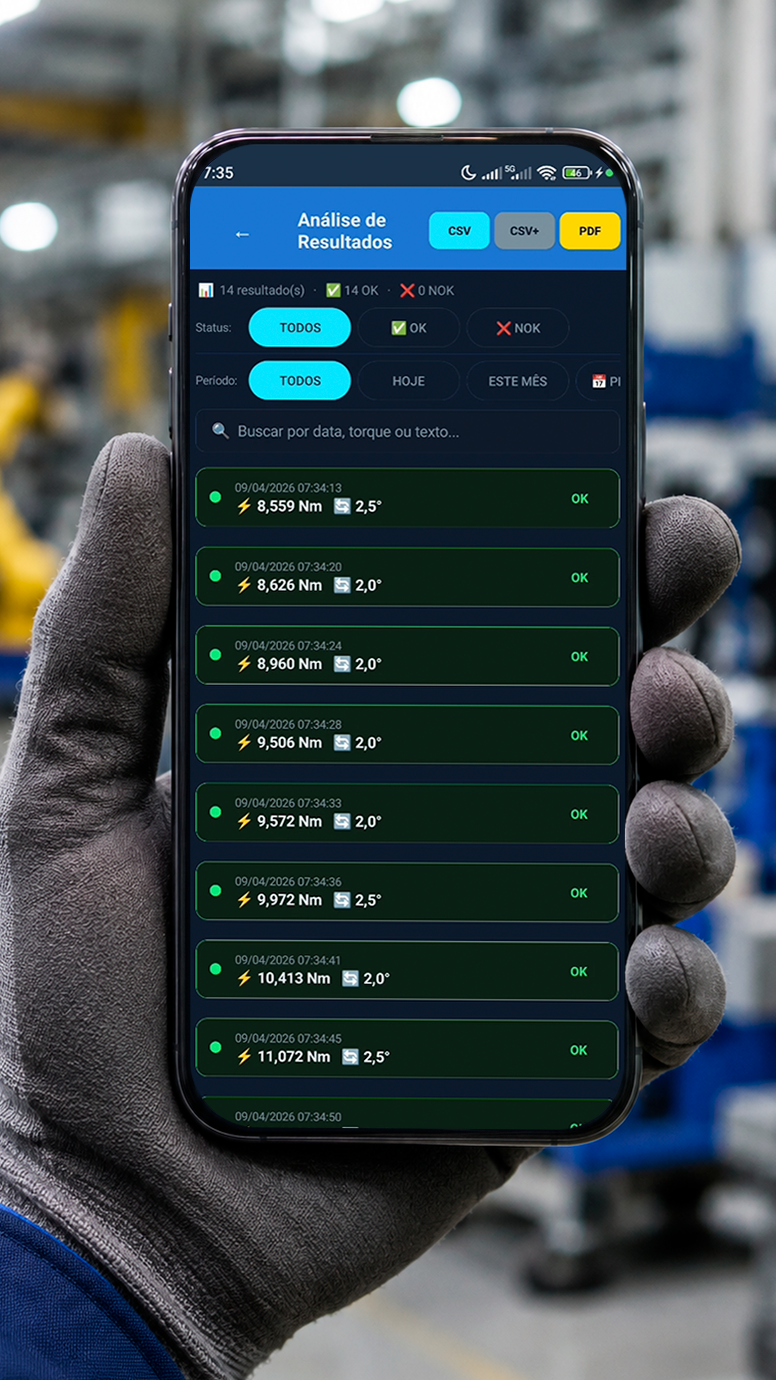
Result History: Store measurement data and fastening curves in a local database for traceability and analysis.
Data Export: Export measurement results in CSV format, statistical reports in PDF format, and reports containing fastening curves.
Two-Way Synchronization: Communicate with MSqnet QA via TCP/IP, receiving test routes and returning measurement results.
Access Control: User login, user profiles, and device-linked licensing.
Multilingual Interface: Available in Portuguese, English, and Spanish.
Compatibility: Wi-Fi 2.4 GHz communication with Phoenix Wi-Fi Series rotary torque transducers.
How It Works
MSqnet DCL → Phoenix Transducer → MSqnet DCL
Optional: Connection to MSqnet QA
Test routes and registration data are configured directly in the app. The operator performs the fastening tests using the Phoenix torque transducer, while MSqnet DCL collects, processes, and evaluates the measurement results.
Industrial Application
MSqnet DCL is particularly suited for torque control, fastening process verification, and torque measurement analysis, transforming torque data collection into traceable and analyzable process data.
In Free Test mode, for example, the application allows operators to configure minimum, nominal, and maximum torque limits, sampling frequency, threshold, tool type, and other process parameters before data collection begins.
This enables more reliable fastening process monitoring, supporting quality control, process validation, traceability, and statistical analysis of critical torque applications.